Sonata:
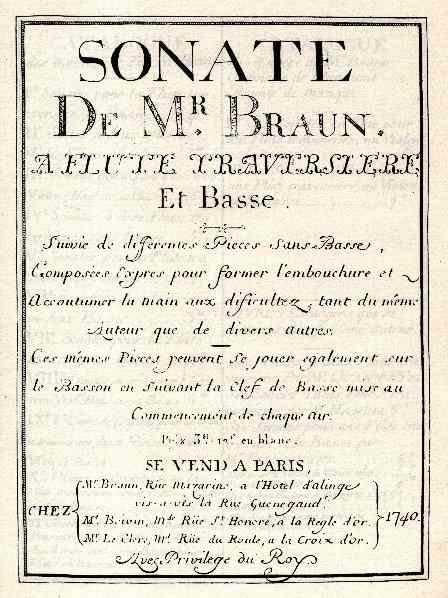
Del Sigr. Le Brun.
Despite the title on the manuscript, this
is a sonata of Jean Daniel Braun. The Lilypond source is
here.
The manuscript can be found at the
Danish
Royal
Library. They also have Braun's solo exercises for flute
online, and huge numbers of further things as well! How
pleasant it would be if the other libraries of the world also
adopted such a progressive approach to making their old
manuscripts easily available. Yes, Denmark is a wonderful
country! We have often been there on holiday.
The reason I have become aware of this
internet presence of the Danish Royal Library is that
recently, I found that Scott Smith of Johns Hopkins University
has an internet page of
Baroque
Flute
Resources, and he has included a link to this page of
mine. But also he has a link to the Danish Royal Library.
There is just so much there that I hardly know where to start.
(And, of course, in the end one only has time to do just a
little.) But since I enjoy Braun's exercises, and also I have
a facsimile collection of some trio sonatas of his which we
have found to be nice, I thought I would see if the people in
Denmark have anything of Braun. So this turned up.
The manuscript, which comes across as a pdf
file, is almost sufficiently clear to play from it if you
print it out. The copyist had a very clear style. (And I have
no idea why he decided to change Braun's name into "Le Brun".)
Still, my project here is to put these things into Lilypond,
so why not? And I think it turns out to be a very pleasant
sonata. It is a bit like a finger exercise, particularly in
the last movement. But it has the merit of being not trivial
for the cello, or viola da gamba player who accompanies you.
I've also downloaded a sonata of Abel, but
have not yet gotten around to looking at it very much. It
seems to be the very same copyist at work there as well. Could
it be that this was somebody in the employ of the Danish court
back in those days, who was set the task of writing these
things out as cleanly as possible?
In any case, not all accidentals are
written out explicitly. Since I've really just put this in the
computer in order to play it myself, I decided to let Lilypond
use the "modern cautionary" accidental style, which seems to
me to be most clear. I wasn't quite sure what to do about the
page turnings. The allegro is really too long to squeeze it
onto two pages (and this is only the 20 point font). The
manuscript has it on two and a half pages as well, but then
the gavotte is on a single page, which again would be too much
of a squeeze. The manuscript seems to be in a bound folio, and
there is a page turning at the repeat of the allegro. So that
would also be possible here.
After playing this sonata a few times, I
find that the articulations of the allegro movement - as they
are written in the manuscript - are too confusing. As is
often the case with this baroque music, the pattern of
articulation is given in the first few bars, then the copyist
doesn't bother to continue writing it in, assuming that the
performer simply carries on as before. But somehow that tends
to overload my brain in this instance, so I've written what
seems to me the sensible continuation of the articulation
throughout the allegro. And to further reduce the mental
effort, I have also written in more of the accidentals than
was done in the manuscript.
##########
Sonata:
Del Sigr. Abel.
(With lilypond
source.)
This is another sonata from the Danish Royal Library, this
time by Carl Friedrich Abel in his typically gallant style.
Although Abel was the last great viol virtuoso, the bass line
of this sonata is simple. The copyist included a much more
detailed account of the articulations this time. But I did
feel compelled to correct one note in bar 42 of the allegro.
When writing a grace note, we must specify
some sort of note duration; usually they are written as
eighth, or sixteenth notes. Some people take these durations
seriously, and play them as if they were non-grace notes in
the normal line of the music. Thus I suppose a sixteenth grace
note standing before a half note would be played as an abrupt
impulse, followed by a long note where one tries to recover
ones balance from this sudden stumbling feeling which has just
pushed us off balance.
In this sonata, Abel - or at least his
Danish copyist - has made it impossible for such pedantic
musicians to play in such a way. For example we have many
instances of grace notes which are written as eighth notes,
standing in front of eighth notes. (Bar 3 of the Adagio, etc.)
And then in bar 78 of the Allegro, there is a sixteenth grace
note before a half note. Whatever the logic of all this is, I
have tried to give an accurate reading of what is there in the
manuscript. In any case, I have found that by ignoring such
problems, the sonata becomes a very pleasant piece of music.
Modern musical academics have given Abels
various works their opus numbers. I don't know if the Danish
Royal Library knows how to classify this work, but in any
case, they do not quote such a number in their catalog.
##########
Binicien: Orlando
di Lasso.
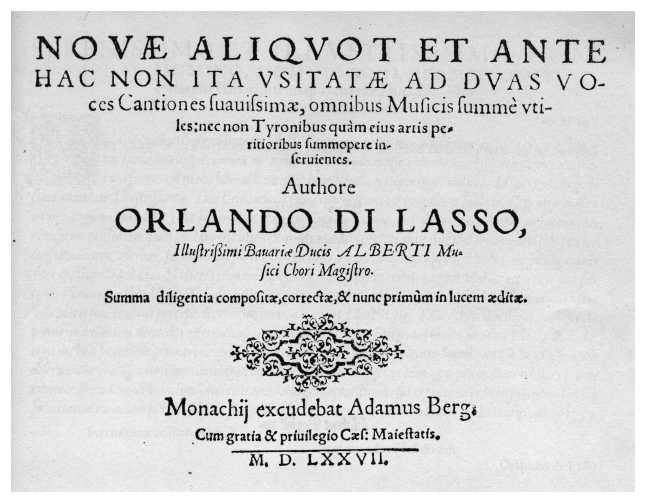
This music, published in 1577, consists of 24
pieces for two instruments: vox superior and vox inferior. The
title page is
here, and the source
here.
The first twelve pieces are songs - or perhaps one would say
madrigals - all in Latin. For singers, the challenge is perhaps
not best expressed in rapidity of execution! In any case, we have
found that when playing them with flute and viol, there is no
great technical challenge. On the other hand, the last twelve
pieces are a different matter all together. Only by putting the
two voices together in a single score like this have we been able
to gradually begin to play this music in a sensible way.
Some of the pieces begin with lots of long
notes, then suddenly there is a change of character, with many
short notes. When setting this music and checking for mistakes by
letting the computer doodle through it with the MIDI interpreter,
following an electronically exact and unwavering tempo from
beginning to end, this abrupt change in perceived tempo becomes
laughable. In 1577, Lasso had neither MIDI players nor even
metronomes! Therefore, I am sure that he would find the modern
tendency to play "classical" music with a metronome-like rigidity
of tempo to be quite unpleasant. So I would suggest that you be
free to imagine that some of these pieces consist of two or more
contrasting phases. For example, number 18 could be played with a
moderate, singing tempo up to bar 46, counting in whole notes, but
then after the rest, one could continue by taking the beat to
consist of half notes. Of course number 21 involves three quite
distinct phases. The tempo of the single whole notes in the first
and last parts should perhaps equal the tempo of three whole notes
in the triple time part in the middle.
I have let Lilypond transpose a number of these
pieces into a range more comfortable for my tenor flute. Of course
you can obtain the non-transposed source simply by erasing the
"\transpose" instruction. In particular, the number 20 was too low
for us. In the original key, written as if it were c major, only
few accidentals appear in the source. However, in reality many of
the b's should really be played as b-flat. So the whole thing
tends towards f major. But then, unfortunately, the transposition
upwards means that the flautist must play lots of e-flats. How
unpleasant! On the other hand, if, for example, you have two
viols, then I'm sure it sounds equally good, both in the original
key and in this transposition.
In any case, these pieces certainly have much
more character, and they are a greater challenge, than the
renaissance music which was written by some of the more obscure
composers from that period.
##########
Il Dolcimelo:
Aurelio Virgiliano.
This comes from the
facsimile
of a hand-written manuscript which was written around the year
1600. It includes drawings of viols, zinks, and other chamber
instruments of the renaissance period, including flutes, together
with fingering charts. There are tables of standardized musical
ornaments, as were published back then by Ortiz and Ganassi. And
then also a section of 13 rather long ricercatas. In most of them,
the ink seems to have spread out into black smudges, obliterating
the notes, rendering everything unreadable. But thankfully three
of them are almost totally free of smudges and can be easily read;
namely the ricercata 6, 7, and 8. The Lilypond source is
here.
I have corrected things in one or two places, adding in a single
note so that the rhythm comes out right. The numbers 11 and 13 are
reasonably readable, and they are also suitable to be played on
the renaissance flute. Number 12 is almost completely free of
smudges, but it is written for the viola bastarda and is thus not
suitable for the flute.
Perhaps I would have continued with 11 and 13;
however when browsing about the internet, I discovered that
London
Pro
Musica have published an edition of all 13 of these
ricercatas in modern notation. How they could ever make sense of
the smudges in number 4 is beyond me! So I must take off my hat to
them. Perhaps the original manuscript has retained more of the
original notes, shining through the smudge, than can be seen in
this facsimile.
In any case, the manuscript has endlessly long
chains of eighth notes, all joined together with a single long
beam with curlicues at the ends. It looks appallingly unmusical.
But then when transforming it into modern notation, it does take
on a certain amount of form. Interesting rhythms. At the
very least they provide scale exercises in the style of the
renaissance, and some idea of the practical ornamentation in those
days. But certainly nobody would say that they are suitable for
performance, as for example the pieces in Ortiz book are.
##########
Three Sonatas:
Johann Philipp Kirnberger.
The facsimiles of these sonatas were also
downloaded from the the online collection of the Royal Danish
Library (the link to which is
here). They
are
numbered five to eight, so I suppose the library must have the
numbers one to four in their collection as well. Hopefully they
will also be put online in the future.
I have only set the sonatas 5 to 7 here, not
bothering with number 8 since it was published by
Schott
as a single edition many years ago. I bought it for 19.50 (I'm
sure that was back in the DM days, before the introduction of the
Euro; even so, the price seems to me to be rather steep for just
one single sonata of printed music). Well, it was worth it.
After all, since, as professional publishers, they went to
the trouble of writing out some chords for the right hand of the
harpsichordist, I was able to play it in a more serious way.
In contrast to that, I have only set the flute
part and the bass line in the three sonatas here, ignoring the
bass figures. My mind is too simple to imagine going beyond the
linear notes of the flute, so it would be nonsense for me to try
to invent the chords which a keyboard player would use. And few
people these days are comfortable playing from the figured bass
alone. But for flute and viol, or cello, this is enough. And
anyway, if anyone needed the figures, it wouldn't be difficult to
add them in using Lilypond.
The Schott edition doesn't bother to include a
Preface, explaining what the sonatas are. The Danish library also
gives no further indication. In addition to these, I have three
other sonatas of Kirnberger in other editions, and they are all
different from the sonatas here.
Of course Kirnberger is perhaps best known for
the system of tuning keyboard instruments which he published in
his famous
Die Kunst des reinen
Satzes. He had earlier been with J.S. Bach in Leipzig, so
it is reasonable to say that this system represents Bach's
Well Tempered Klavier tuning.
Kirnberger published his treatise later, in his capacity as music
master to the princess Anna Amalia of Prussia in the 1770s. But he
was a violinist in Frederick the Great's palace orchestra as early
as 1751, so it is clear that the flute sonatas which he wrote were
intended for the King. I often enjoy playing them. Afterwards,
when riding my bicycle, or whatever, I find the melodies
continuing back and forth in my head.
Probably most music historians would not rate
him as being one of the all-time greats in the pantheon of the
music world. The Oxford Companion to Music gives him about two
inchs in a single column on one page. The Grove Concise Dictionary
of Music gives him about the same (in a smaller typeface), but
they say that his compositions are "correct, but uninspired".
My theory is that these music historians are
all keyboard players, and so they cannot be inspired by the linear
melody of flute music. It seems to me that Kirnberger kept the
bass line very simple so as not to irritate Frederick; yet it does
have an interesting linear pattern, not only accompanying the
flute, but leading it as well. Thus the great musicians of the
court orchestra, with C.P.E. Bach at the harpsichord, could have
improvised a wonderful music around these sonatas.
##########
Bicinien: Antoino Troilo.
The facsimiles of these bicinien are
quite clearly printed and so don't really need this transcription
into computer typesetting. The reason I have done it is that the
different pieces have widely differing ranges - for example the
tenor part starts off in the tenor (or C4) clef in the duos 1 to
8, then in 11, 12 and 13 it jumps up to the treble clef. Thus, in
order to play them easily on the tenor flute, together with bass
viol, I wanted lilypond to transpose them automatically into
sensible ranges for those two instruments. However, since I see
that some people are actually looking at this internet site of
mine, I thought it would be best to remove the "transpose"
instructions from the lilypond source (
here)
and simply give you the non-transposed version of this music,
leaving you to transpose things into the best range for whatever
combination of instruments you might be using.
These are quite lively pieces. And I find it
interesting that Troilo describes the moods of the various
sections of each duo by calling them "capricios", "scherzos",
"sinfonias", and so forth. Since most of the pieces have more than
one such description, it is clear that we should look for changes
in mood while progressing through the music.
When I got to the duo number 10, I stopped,
since that piece made no sense at all. Somehow the printers in
Venetia back then in 1608 seem to have garbled things up to such
an extent that the middle part of the piece is totally
unintelligible. This put me off the whole business for weeks; but
then we decided that we were getting tired of playing the same old
stuff over and over, and therefore I resolved to proceed onward
with 11. Eventually, I came back to 10 and just invented a few
notes of my own in the middle of the piece - leaving things for
the most part unchanged. At least it does now come out more or
less correctly. Also I have changed the notation in the 21st
piece, but without changing any of the notes. In the original
printing, things waver between the C4 and the C3 clefs in the bass
line, and between the C1 and G clefs in the canto line. This seems
to me to be a ridiculous complication. But also the key changes
back and forth between having b-flat, and not having it. In such a
short piece this only leads to confusion; and anyway, the computer
can automatically put in the flat symbol for the few bars here and
there when we are in a flat key.
I did google the name Antonio Troilo, and I
find that there are numbers of Italian people living today with
that name. But I also find that I am not the first person to have
had the idea of typesetting this music. It seems that a number of
publishers are selling editions of Troilo's music in modern
notation. Perhaps they are superior to what I have here. Perhaps
my confusion with the tenth piece has a more sensible resolution
than that which I have found. But at least we find it to be
pleasant to play from this (pseudo) mensural notation, and it is
easier than playing directly from the facsimile, since we can see
each others music while playing.
##########
Biciniorum: Sethus
Calvisius.
This music is a collection of duets put
together by
Sethus
Calvisius. Apparently his real name was Seth Kalwitz, and he
became the Thomas Cantor in Leipzig in 1594; that is 150 years
before the great Johann Sebastian Bach had that position. Sethus
Calvisius was not only an organist; he was also a mathematician
and an astronomer. His Biciniorum was published in the year 1612,
and the Royal Library at Copenhagen has made its copy accessible
on the internet. Most of the duets are songs of a religious
nature. But it finishes off with a mixed collection of fifty
instrumental duets which I have typeset here.
Calvisius used a number of the duets in the
book of Orlando di Lasso which I had already typeset, thus
allowing me to simply copy them over into this collection.
Nevertheless, it has taken me some time to finish this project.
And the printing in the facsimile presents the reader with certain
problems.
Some time before 1600, music notation changed,
so that the beat of the music was generally given by the half
note, rather than the whole note as had been the case before that
time. This was an unfortunate development which only made reading
the music more difficult. After all, it is very easy to
differentiate between the longa, the breve, the whole note and the
half note. Each of these has a totally different form from the
others. And if one of those notes was filled in with black, then
that had a different meaning to the meaning which is assigned in
modern notation. But if, as in this music from 1612, everything is
based on the half note, then most of it consists of half notes and
quarter notes. They look identical except for the fact that the
quarter notes are filled in with black. Then the eighth notes are
again identical with the quarter notes, except for a little
curlicue attached to the stem.
The problem is that in this old book, the ink
has often faded, or smeared, leaving a certain scope in deciding
if a given note is black, or not. Or if a smudge is a curlicue, or
not. And looking closely at the printing, it seems that the black
notes were produced by the printers in those days by simply
scratching the printing plates, thus producing only scratchy
filled-in notes in the first place.
But even with touched-up facsimiles which are
as clear as the original printings of the 17th century, such as
those offered by Spes-Editore in Florence, it is often difficult
to read this style of music. There are no beams to guide the eye,
and it is very easy to miss the odd quarter note sitting in the
middle of a collection of eighth notes. All those identical stems
make the eyes swim!
Therefore, when setting this music, I often
found that it didn't come out right. Listening to the midi
reproduction, it was usually possible to find where I had confused
one kind of note with another. But then it soon became clear that
the printers of 1612 had also made many typographical mistakes.
There is a page of corrections included in the book (or errores
insigniores sic corrigantur, to use the quaint Latin of those
days). Yet I find that there were numbers of additional mistakes
not listed in the errores, and so I have taken the liberty of
altering a few notes here and there.
However the duet number 69 was beyond repair.
In the vox inferior book, the piece in the 69th place is numbered
LIX, rather than LXIX. Yet it is different from the LIX piece
earlier in the book. After pondering this problem with the missing
LXIX, and letting myself be carried away with frustration, I have
simply left it out of the collection here. One possible solution
to this LXIX problem would be that the librarians in Copenhagen
made a mistake while scanning the thing. On the other hand, the
fact that there is a sensible LIX speaks against such a thesis.
But also the following piece, LXX, had many mistakes. After some
experimentation, I was able to find a combination of notes which
does give a more or less reasonable rendition of LXX. Thus it
seems to me that there must have been some problem with the
printers back in 1612. Perhaps they let a disgruntled apprentice
have a go at it, and couldn't be bothered to correct all his
mistakes.
I wouldn't say that each of the pieces here is
wonderful music. It is a very mixed collection. But at least the
pieces by Josquin des Prez are well worth playing. I have
reproduced the spelling of names as they are found in the book.
Most - although not that of Josquin - have been latinized in
strange ways.
In order to permit double-sided printing and to
avoid page turnings, as in Calvisius' books, I have printed most
of the pieces over two pages. This has resulted in some of the
shorter pieces becoming somewhat uncomfortably widely spaced. But,
as in the original, the last piece by Brumel does require a page
turning. However we can avoid this problem by printing it
single-sided.
##########
Tonus de Canto:
Hieronymus Scotus.
These duets are the last pieces in the
book
of "villancicos", which was published by Girolamo Scotto in
1556. The only surviving copy, from which the facsimile was made,
is in the Uppsala University Library in Sweden. For this reason,
the book is known as the "Cancionero de Upsala".
A
villancico
is apparently a village, or folk song of the Iberian Peninsula.
But the genre expanded to include religious motives. Thus the book
contains 54 of these short, simple songs, all of which have much
melody, written for between two and five voices. The title of the
book, in the English translation given in the link above, is:
"Villancicos from various
authors, for 2, and 3, and 4, and 5 voices, now again revised.
There are also 8 tones of plainchants, and 8 tones of organum
for the benefit of those that are still learning to sing.
Venice, by Geronimo Scotto, 1556"
I have set the "8 tones of organum" part here.
These are without words and are certainly not simply melodious
songs. One reason for setting this music was in order to transpose
it into ranges more suitable for the renaissance flute and bass
viol. However here, I have left as it is in the original. Another
reason is, of course, that the facsimile is often rather difficult
to read, and furthermore, while the two voices are on facing pages
in the book, still it is impossible to follow both while playing.
The lilypond source file is
here.
The original contained a mistake in the seventh
duo around the bars 102 to 105, so I have made a couple of
alterations there. There was also a small correction necessary in
one of the earlier duos, but I have been setting this music very
gradually and so I've forgotten where it was.
##########
Der Brauchbare
Virtuoso: Johann Mattheson.
The German word "brauchbar" means
"useful" in English. So it is unclear what Mattheson was trying to
say with this title. Does he suggest that all those virtuosos
could try and make themselves useful by playing these sonatas? Or
does it mean that dilettantes who might have bought these sonatas
when Mattheson had them published in Hamburg, in 1720, by doing so
have shown that they are - or at least are trying to become -
useful musicians? One way or another, after printing the title
page in the usual style of those days with all its frills and
exaggerated expressions, there follows three pages, dedicating the
work to a couple of other musicians. (In those days, Hamburg was a
free city, not subject to
the oppressive ballast of some minor Duke, or Prince, or
whatever.) Then comes 14 pages of writings which, at least for me,
are extremely difficult to read. For one thing it is set in that
old, almost unreadable Germanic fraktur style of printing. It is
divided into sections with the titles: "Prologus", "Actus Primus",
"Actus Secundus", "Actus Tertius", and "Epilogus". It's all meant
to be witty, with involved, ironic, archaic words, almost
impossible to decipher now, in a world which has changed beyond
all recognition from the world of Hamburg in 1720.
In those days, the oboe was considered to be
much more useful than the flute. This can be seen not only in
paintings from the time, and diagrams of the seating arrangements
for orchestras. But also it was very common to have the oboe
playing along with the strings in most of the pieces, say in a
cantata or an opera, and then in the middle of things, we might
have an isolated solo for the flute, perhaps together with the
soprano, giving a peaceful, ethereal contrast,
without
oboe. So it seems to me that it must have been the practice in
those days for the oboe player to also play the flute. Indeed,
both Quantz and Hotteterre mention this. So it may be that
Mattheson's idea when publishing these sonatas was to provide the
oboe players of his time with some material with which to become
better acquainted with the particulars of the baroque flute. It is
certainly true that some of these pieces are more like études than
anything else.
Johann
Mattheson was a good friend of Handel. However, famously,
they did have a duel after a performance of Mattheson's opera
Cleopatra, in Hamburg in
1704, where Mattheson nearly killed Handel. Whatever the merits of
that opera might have been, they soon made up and became friends
once again. Mattheson wrote numbers of operas, cantatas, and so
on. They were stored in the archives of Hamburg, but became lost
after the upheavals of World War Two. The present sonatas were not
lost. The Royal Library of Denmark retained both a copy of the
original printing, and also a hand copy of the music. Both can be
downloaded as pdf files
here.
At first, I thought that the Danish library only had the hand
copy, and thus I looked through the catalog of S.P.E.S. in
Florence, seeing that they do have a facsimile of the printed
work. It has been 12 or 15 years since I last ordered something
from S.P.E.S. Back then, you just rang them up on the telephone,
and they sent you what you wanted. Most of the music only cost 15
or 20 thousand lira, which would be about 7 or 10 euros. What a
shock it was to find out that Der Brauchbare Virtuoso now costs
€31.90! A rate of inflation of over 300%! And then the shipping
costs would have been €20.- or something! I will restrain myself
from indulging here in a diatribe on the evils of the common
European currency. But at least I did discover that there is
another publisher of this facsimile music, offering things at a
more reasonable price. Namely "Performers Facsimiles, New York".
Very much to be recommended!
Unfortunately though, when I got the facsimile,
I found that the printing technique used by Mattheson's Hamburg
publishers was terrible. It was an attempt to use the primitive
"single-impression" printing to cope with the more modern style
musical notation. It is difficult for me to understand how such a
monstrosity could have been produced in those days, considering
the fact that Walsh in London was producing beautifully engraved
music. And Mattheson himself was an Anglophile, often visiting
London. Anyway, all of this led me to typeset the music for
myself, but using the more readable hand copy. Not only is it more
readable, it corrects some incredible mistakes in the original
printing. For example, the first sonata is written in the key of
D-major, but in the printing, it is written as if it were in
G-major, with huge numbers of C#'s everywhere! The figured bass is
then correspondingly "baroque" in the printed edition, owing to it
being in the wrong key. I did see that in the newer Lilypond, it
is possible to put the bass figures between the staves, and so I
started setting that as well. But the figures in Lilypond are much
too big, disrupting the whole appearance of the score, and anyway,
for our combination they are not necessary, so I gave up on that.
As mentioned above, most of Mattheson's music
became lost after World War Two, but then in 1998 it was
rediscovered in the town of Yerevan, in Armenia, and so it was
returned to the Library of the University of Hamburg. Amongst
those manuscripts was the Christmas Oratorio called "Das Grosse
Kind" (The Great Child). We performed this work a couple of years
ago for the first time since its last performance in the 18th
century, playing at the lower intonation of "a"=392. Of course I
am unable to play the oboe, but I was able to try my hand at the
beautiful flute solo in the middle of the work. Perhaps for this
reason, I find the 12 sonatas in Der Brauchbare Virtuoso to be
pleasant, and I enjoy reading Matthesons words of admonition and
encouragement for the dilettante at the beginning of the printed
edition.
##########
Il
Primo Libro a Due Voci: Bernadino Lupacchino & Ioan Maria
Tasso.
There are 39 pieces in this book (of
course, in the facsimile it is two booklets: tenor and cantus)
which was published in 1560. On the title page, the name of the
first composer, Lupacchino, is printed in a very large type, then
a line below, Tasso's name appears in a type only half as big.
Googling these names produces numbers of sites advertising modern
editions of their music, with no information about their lives.
But when playing the music, one does have the impression that the
pieces of Lupacchino are often more interesting and melodious than
those of Tasso.
While the facsimiles are quite clear, the
different pieces are written in differing registers so that a
certain amount of transposition is necessary. Nevertheless, I have
left them here as in the original so that you can transpose them
as you would like. It is often the case with these renaissance
facsimiles that the printing contains numbers of typographical
errors. Particularly with the number 27, it took some time to find
the mistakes.
In the original printing, exactly 39 pages are
used for the 39 pieces, and no page turnings in the middle of
those pieces are required. But that is not to say that all the
pieces are equally long. Some are quite a bit longer than the
others, flowing over onto the second page, thus leaving only a
couple of further lines for a short piece to fill up the second
page, sometimes accompanied by the word "Residuum". Such short
pieces are written in alla breve. Since I have let each piece
start on a new page, and each page contains both parts, we end up
with 67 pages, rather than the 39 of the original.
##########
A note about
Lilypond:
What I had written here concerning Lilypond has
become rather outdated. I had complained about the fact that the
syntax was continuously changing from one version to the next, and
the different versions seemed to replace one another at short
intervals. But now, thankfully, the developers of Lilypond seem to
have settled on the stable version 2.10, and I think that has
remained the distributed version for almost the last two years (as
of August 2008). There are still many features which I have yet to
discover. For example, I had always had trouble trying to get the
music to fit evenly onto a given number of pages. But now I have
discovered the simple method of specifying the "system-count",
which should be put into the "\layout" block of a score.
It has been a year or two since I have added
anything here. They have now reached the version 2.15. But I am
still in the version 10.04 of Ubuntu Linux, and that includes the
version 2.12.3 of Lilypond. At least up to that version, the
developers of Lilypond have not changed the syntax to any extreme
degree. Version 2.12 was able to compile older music, written in
the syntax for version 2.8. And on the positive side, there are a
number of improvements in the appearance of the finished score.
****************************
Feeling free to copy things
Just to be clear on this, I've thought it might
be a good idea to include the "creative commons" license here.
Namely:

This work is licensed under a
Creative
Commons Attribution 3.0 Unported License.
Which is to say that I hope as many people as possible might find
some value in the sheet music which I have put together on this
site, and thus freely copy it. I have only used facsimiles of
original editions of music which appeared hundreds of years ago.